

Qualitative Lead(s)
Bryher Bowness
Project Lead & Team
Supervised by Professor Vanessa Lawrence & Professor Claire Henderson
Collaborators include Peter Bates, NIHR carers’ steering group, five family carer coresearchers from the community, Oxfordshire Recovery College staff and volunteers
Project Dates
2021 – ongoing
Funding Source(s)
Bryher is funded through the LISS Doctoral Training Programme, Economic & Social Research Council (UKRI)
Qualitative Design used
Field of Research
Family carers, Recovery Colleges, participatory research methods
Geographic/Contextual Setting
Recovery Colleges in England
Recovery Colleges offer free, coproduced, educational courses promoting mental health. Around 10% of people who attend are family/ friends/ carers of people with mental ill-health. This PhD set out to explore family carers’ experiences of attending Recovery Colleges, to understand how we can better include and support them. I first conducted a systematic review to establish recommendations for involving family carers in research, then coproduced a focus group study with family carers and staff across Recovery Colleges in England. Finally, I conducted a Participatory Action Research study with a group of family carers and Oxfordshire Recovery College to deliver and evaluate a course for family carers; Nurturing Creativity whilst Caring. During my research, we experienced barriers to involving a peer researcher in data collection in the NHS, so I also worked with governance teams to explore these issues and potential future recommendations.
Qualitative Approach and Methods
Aim of the qualitative component
Qualitative research methods allowed me to take an inductive approach to explore experiences that had not yet been researched. They revealed the nuances and tensions that family carers experience whilst supporting someone with mental ill-health, and the wide variety of things that can help them on their own, interconnected, recovery journeys.
Qualitative methodology
Collaborative Data Analysis using Reflexive Thematic Analysis grounded in critical realism and emancipatory Participatory Action Research methodology
Which qualitative methods were used?
Focus groups, interviews, open online questionnaires, reflective discussions, participatory arts-based methods, researcher observational notes
Sampling & recruitment
A family carer coresearcher helped design the recruitment strategies for the focus group study, and Oxfordshire Recovery College and a Family Carers’ Advisory Group codesigned the recruitment strategy for our Participatory Action Research Study
Data analysis: how the team made sense of the data
Systematic review:
We used a narrative synthesis (Popay, 2006) approach to analyse the wide variety of data extracted from the studies involving family carers in conducting health research. This included thematic analysis, alongside applying other frameworks, such as Wright and colleagues (2010) ‘Critical appraisal guidelines for assessing the quality and impact’ and Sweeney & Morgan (2009) ‘Levels and stages of service user/survivor involvement in research’, to explore differences and commonalities in participatory approaches, their benefits, challenges, and facilitating factors.
Focus groups:
Myself and two family carer coresearchers conducted Collaborative Data Analysis following the steps of Reflexive Thematic Analysis. We also held an online interactive webinar with a wide audience of Recovery College staff, students and researchers, where we considered the findings and discussed future recommendations.
Participatory Action Research:
Our Participatory Action Research methodology required a holistic, iterative, collaborative and flexible approach where participants, Oxfordshire Recovery College staff and the family carer coresearchers’ interpretations of the data were influential in shaping our themes exploring the students’ experiences of our coproduced courses. We combined researcher notes from the course sessions, an interview, and also verbatim feedback from anonymous online feedback surveys during and after the course.
I also held several collaborative reflective discussions with Research Team members to encourage reflexivity on our Participatory Action Research process.
Findings, Learning & Impact
Summary of main findings
Participatory research with carers
My systematic review pulled out the following themes that summarise the challenges, facilitating factors and benefits of involving family carers in research: (re) building relationships with carers, carers as equals not afterthoughts; carers have unique experiences, carers create change. The literature demonstrated ways for carers to contribute in ways that suited them, maximizing their impact, while attending to relationships and power imbalances.
A theme throughout my research into participatory research methods, and my own experiences conducting these approaches, was the remaining institutional barriers to equitably involving people with lived experience in research.
Understanding family carers’ experiences of Recovery Colleges
Through collaborative data analysis of our focus groups, we found the following themes: The ‘carer’ identity is not clearcut’, Recovery ethos applies to family carers too, Power of lived experience, Educational focus is appealing, Family carers deserve recognition and provision and Reaching out and fitting around family carers. Attending Recovery Colleges developed family carers’ understandings and gave them skills to navigate services and support themselves and others. This furthered their own recovery journeys. Shared learning spaces were helpful, but participants felt Recovery Colleges were not oriented towards family carers. In an interactive webinar, we developed recommendations for how Recovery Colleges could increase relevance and accessibility for family carers.
Nurturing creativity whilst caring
We developed three themes summarizing the learning of family carers’ who attended our coproduced online course at Oxfordshire recovery College: self-care as a family carer is complex, but there are small steps we can take to create time to nurture ourselves, creativity connects family carers with others and ourselves, and nurturing a creative mindset for caring. We reflected on the advantages and challenges of our Participatory Action Research approach, with key learnings that collaborating with the Recovery College enabled ongoing impact whilst involving family carers in this empowering research methods furthered their recovery journeys too.
Links, Outputs & Resources
Links to publications
- Bowness, B., Hayes, D., Stepanian, K., Anfossi, A., Taylor, A., Crowther, A., Meddings, S., Osman, Y., Grant, J., Repper, J., Ronaldson, A., Henderson, C., & Slade, M. (2023). Who uses recovery colleges? Casemix analysis of sociodemographic and clinical characteristics and representativeness of recovery college students. Psychiatric Rehabilitation Journal, 46(3), 211–215. Available here.
- Bowness, B., Henderson, C., Akhter Khan, S. C., Akiba, M., & Lawrence, V. (2024). Participatory research with carers: A systematic review and narrative synthesis. Health Expectations, 27(1), e13940. Available here.
- Bowness, B., Bates, P., Chauhan, A., Osman, Y., Shlovogt, T., & Lawrence, V. (2025). Peer researchers in NHS research: Approved in principle, undermined in practice? Research Involvement and Engagement, 11(1), 63. Available here.
- Bowness, B., Begum, S., Bicknell, S., Samuels, L., Shah, S., Hess, S., Martin, K., Bark, D., Henderson, C., & Lawrence, V. (2025). Nurturing Creativity whilst Caring: Participatory Action Research with family carers and a Recovery College. Frontiers in Psychiatry, 16, 1607560.
- Bowness, B., Bicknell, S., Samuels, L., Osman, Y., Kellermann, V., Henderson, C., & Lawrence, V. (2025). Understanding the experiences of family, friends and carers attending Recovery Colleges: focus group study. BJPsych Open, 11(2), e43. https://doi.org/10.1192/bjo.2024.852
Creative/visual materials
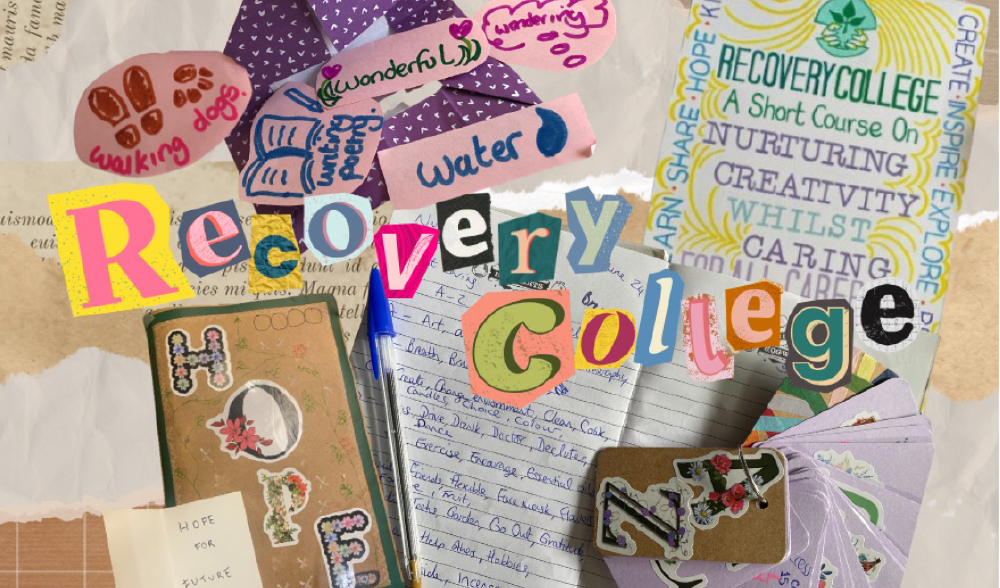
Participatory research with family carers
I co-delivered a talk with a carer in an NIHR webinar held during the 2022 Carers Week – the event report can be found here. I then worked alongside the NIHR Carer’s Steering Group to develop some resources for carers and researchers on involving carers in research:
- one set for researchers to support the inclusion of carers in their research
- another set for carers to support them to get and stay involved in research
Read our blogs:
- https://www.nihr.ac.uk/blog/why-is-it-important-to-involve-unpaid-carers-in-research/33511
- https://www.quahrc.co.uk/impact-in-qualitative-research-bryher-bowness-on-co-producing-guidance-for-researchers-and-the
Working alongside Peter Bates – Peter Bates, we recently collaborated with the Joint Research & Development Office of IoPPN and SLaM | Institute of Psychiatry, Psychology & Neuroscience | King’s College London to find ways research governance systems can improve their systems for involving peer researchers from the community in conducting research
Read our blog Peer researchers in NHS research: approved in principle, undermined in practice? | Feature from King’s College London
Involving family carers in Recovery Colleges
Together with three family carer coresearchers, we held an internationally attended webinar with over 70 attendees. Through this, we codeveloped the following resources on how to increase accessibility and relevance of Recovery Colleges for family carers: https://drive.google.com/file/d/1TrTEabysnNfsMxGkqq0yNzIGM3nHid6I/view?usp=drive_link, https://drive.google.com/file/d/1Ch6Aj0sdUMFQuaYWOvJKK97upBFNmRRc/view?usp=drive_link
In collaboration with Imroc and Lincolnshire Recovery College, I wrote a briefing paper on including family carers in Recovery Colleges – Ensuring that Recovery Colleges are Accessible to Family Carers – Lincolnshire Recovery College — Imroc
Finally, our most recent research project with Oxfordshire Recovery College and four family carer coresearchers, ‘Nurturing Creativity Whilst Caring’ won an award for national participatory research (view the full list of King’s Engaged Research Awards 2025 winners). We also presented a lightning talk and poster which won second prize at Refocus on Recovery 2025. See – Nurturing Creativity whilst Caring: Participatory Action Research with family carers and a Recovery College.
Read our blog here “Now it’s time for the carers to be involved”: Exploring participatory action research with carers and recovery colleges | ARC South London
Other
Since starting my PhD, I also undertook and Overseas Institutional Visit in 2023 as an adjunct research fellow at La Trobe University, Melbourne, working with Professor Lisa Brophy and Professor Richard Gray. We organized a collaborative seminar discussing Recovery Colleges and potential for their collaboration with universities, with 12 speakers from community organizations and services across Australia, and over 100 attendees online/in person. I then presented findings from scoping the potential for University collaborations with Recovery Colleges through a poster at the Enmesh 2024 conference.
I contributed to the data analysis formation of themes for the following paper –
Averill, P., Bowness, B., Henderson, C., & Sevdalis, N. (2024). What does ‘safe care’mean in the context of community-based mental health services? A qualitative exploration of the perspectives of service users, carers, and healthcare providers in England. BMC Health Services Research, 24(1), 1053. https://doi.org/10.1186/s12913-024-11473-3