
Qualitative Lead(s)
Dr Sharli Paphitis, Jenevieve Mannell, Alexis Palfreyman
Project Lead & Team
Nayreen Daruwalla, Melanie Abas, David Osrin, Sian Oram, Sharli Anne Paphitis, Delanjathan Devakumar, Jenevieve Mannell, Joelle Mak, Cathy Zimmerman, Abhijit Nadkarni, Urvita Bhatia, Devika Gupta, Rukmini Datta, Krishna Panchal, Eaishwarya Natekar, Abigail Bentley, Ayesha Ahmad, Alexis Palfreyman, Safiya Riyaz, Rasika Samanmalee, Sambasivamoorthy Sivayokan, Kavitha Vijayaraj, Lamba Saboor.
Project Dates
2018–2023
Funding Source(s)
NIHR Global Health Research Programme (Award 17/63/47)
Qualitative Design used
- Participatory and Creative Research
- Implementation Research and Improvement Science
- Developing and Adapting Interventions
Field of Research
Domestic violence; modern slavery; human trafficking; global mental health; trauma‑informed care; survivor wellbeing; gender‑based violence
Geographic/Contextual Setting
Afghanistan, India and Sri Lanka; NGO, community and service‑provider settings in low‑ and middle‑income and conflict‑affected contexts
This NIHR Global Health Research project developed a contextually adaptable, trauma‑informed mental health support package for women survivors of domestic violence and modern slavery in South Asia. Using a multiple‑methods, transdisciplinary design grounded in qualitative research and realist synthesis, the project produced a non‑specialist support package and locally adapted manuals to strengthen survivor‑centred mental health care in Afghanistan, India and Sri Lanka.
Qualitative Approach and Methods
Aim of the qualitative component
To understand survivors’ mental health needs, experiences of violence, and pathways to support, and to use this evidence to inform the development of a culturally and contextually appropriate mental health support package deliverable by non‑specialist providers.
Qualitative methodology
Multi‑method qualitative inquiry informed by realist evaluation principles and programme theory development, underpinned by trauma‑informed and socioecological frameworks.
Which qualitative methods were used?
- Semi‑structured qualitative interviews with survivors of domestic violence and modern slavery
- Focus group discussions with survivors and service providers
- Participatory and consultative workshops with survivors, advocates and clinicians
- Qualitative synthesis within realist and mixed‑methods systematic reviews
- Collaborative theory‑building and programme logic development
Sampling & recruitment
Purposive sampling was used to recruit women survivors across diverse sociocultural, legal and conflict contexts, including survivors living in shelters and community settings. Service providers (caseworkers, counsellors, clinicians, legal and NGO staff) were recruited to reflect the realities of non‑specialist service delivery. Recruitment was conducted through trusted partner organisations with strong safeguarding and trauma‑informed procedures.
Data analysis: how the team made sense of the data
Qualitative data were analysed iteratively using thematic and realist analytic approaches to identify survivor needs, mechanisms of change and contextual influences. Findings were triangulated across interviews, focus groups, consultations, service data and literature reviews. This synthesis informed the development of programme theory, articulated through a survivor‑journey model linking resources, reasoning and mental wellbeing outcomes.
Findings, Learning & Impact
Summary of main findings
Survivors’ mental health needs are inseparable from safety, social, legal and economic concerns. Effective support must be holistic, trauma‑informed and flexible, addressing non‑linear recovery journeys and enabling survivors to build agency, coping skills and wellbeing alongside meeting basic needs.
Why were qualitative methods used in this project, and what did they enable?
Qualitative and participatory methods were essential for capturing outcomes that survivors themselves identify as meaningful, many of which are overlooked by narrowly clinical or short‑term evaluation frameworks. Survivor‑led qualitative inquiry enabled a holistic, multi‑level understanding of recovery that spans individual, relational, institutional, and structural domains.
Qualitative methods were essential for capturing survivors’ lived experiences of violence, distress and help‑seeking in contexts where mental health is stigmatised and services are fragmented. They enabled the identification of mechanisms of change, culturally grounded understandings of distress, and practical insights into what non‑specialist providers can realistically deliver.
What was innovative, challenging, or particularly successful about the project’s use of qualitative methods?
- Integration of qualitative research, realist reviews and programme theory to develop a practical intervention package
- Deep engagement with survivors and frontline providers across highly diverse and politically complex settings
- Translation of qualitative insights into modular, non‑specialist training manuals and tools
Lessons learnt / reflections?
The project highlighted the importance of flexibility, long‑term engagement and sensitivity to political and security contexts. It demonstrated that mental health support for survivors must be embedded within broader systems of care, and that qualitative theory‑building is critical for designing feasible interventions in resource‑constrained settings.
Impact & influence
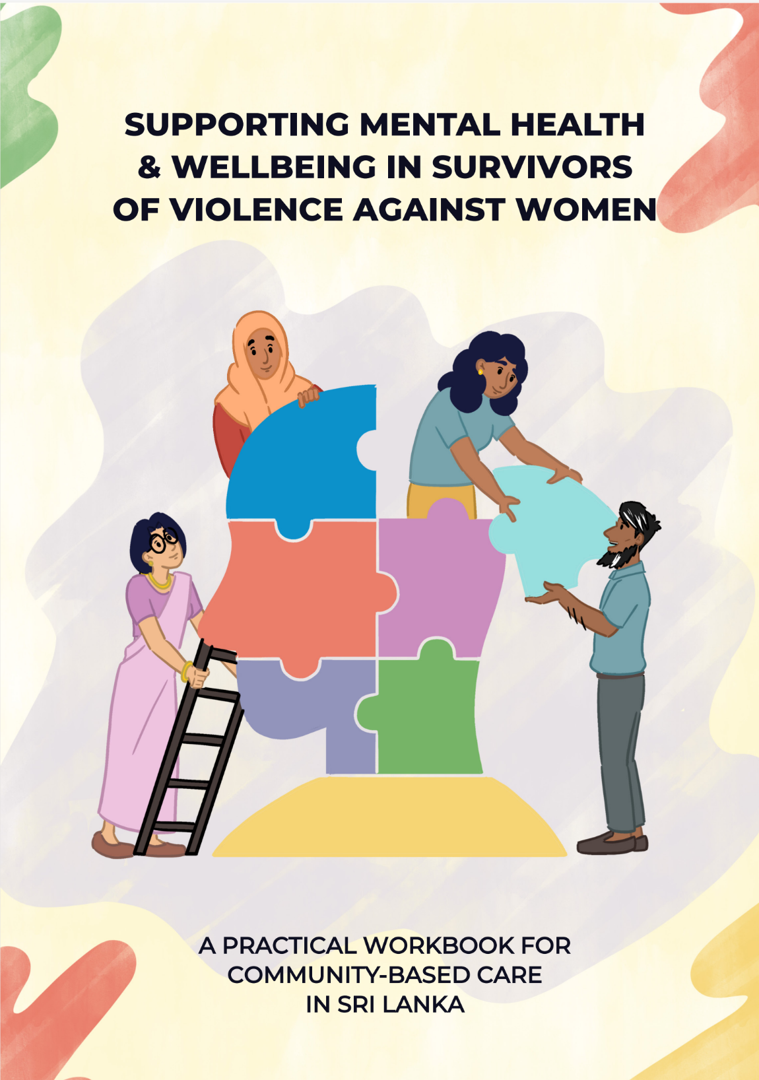
The project produced a core mental health support package and four locally adapted versions for South Asian contexts, alongside training resources and online materials. Impacts include strengthened non‑specialist capacity to support survivor mental health, contributions to global mental health and violence‑against‑women policy debates, and foundations for future implementation and evaluation research.
Links, Outputs & Resources
Links to publications
- Daruwalla, N., Abas, M., Ahmad, A., Bentley, A., Bhatia, U., Datta, R., Devakumar, D., Gupta, D., Kiss, L., Lohia, P., Mak, J., Mannell, J., Nadkarni, A., Natekar, E., Oram, S., Palfreyman, A., Panchal, K., Paphitis, S., Riyaz, S., … Osrin, D. (2025). Developing a mental health support package for women survivors of domestic violence and modern slavery in South Asia: A multiple methods design. Global Health Research, (2), 1–27. Available here.
- Kaul, A., Saboor, L., Ahmad, A., Mannell, J., Paphitis, S. A., & Devakumar, D. (2024). What are the experiences and psychosocial needs of female survivors of domestic violence in Afghanistan? A qualitative interview study in three Afghan provinces. BMJ Open, 14(6), e079615. Available here.
- Mukerji, R., Saboor, L., Paphitis, S., Devakumar, D., & Mannell, J. (2023). How does domestic violence stigma manifest in women’s lives in Afghanistan? A study of survivors’ lived experiences of help-seeking across three provinces. Global Public Health, 18(1), 2212035. Available here.
- Paphitis, S. A., Bentley, A., Asher, L., Osrin, D., & Oram, S. (2022). Improving the mental health of women intimate partner violence survivors: Findings from a realist review of psychosocial interventions. PLOS ONE, 17(3), e0264845. Available here.
- Mak, J., Bentley, A., Paphitis, S., Huq, M., Zimmerman, C., Osrin, D., Devakumar, D., Abas, M., & Kiss, L. (2023). Psychosocial interventions to improve the mental health of survivors of human trafficking: A realist review. The Lancet Psychiatry, 10(7), 557–574. Available here.