
How can Recovery Colleges provide the most benefit to people who use mental health services?
Recovery Colleges are a mental health intervention that use co-produced adult education courses focused on mental health as opposed to more traditional clinical approaches. RECOLLECT aims to find out how Recovery Colleges can provide the most benefit to people who use mental health services. Katy Stepanian, Research Assistant on RECOLLECT, reflects on how qualitative research can help us to answer this question.

What has the team has done so far?
During the first part of RECOLLECT (Recovery Colleges Characterisation and Testing), which ran from 2017-2018, the team used qualitative methods to investigate the main characteristics of Recovery Colleges (RCs); how recovery colleges work; and what sorts of benefits there are for students and staff (of both the Recovery College and in wider mental health services).
What makes a Recovery College a Recovery College?
Because there is such variation in how and where Recovery Colleges operate, part of the work in RECOLLECT involved developing a fidelity measure (a measure used to rate how well an intervention fits to a model) to find out what it is that makes a Recovery College different from other types of mental health interventions. Following a systematised review of the literature, we conducted qualitative interviews to identify the key components of Recovery Colleges from the perspectives of Recovery College managers, students and staff. Through this process we developed and refined a coding framework that acted as the basis for the fidelity measure. Out of 7 key features identified, subsequent statistical analysis suggested that the two most important aspects to defining a Recovery College are coproduction (a form of shared decision-making involving people with lived experience) and taking an approach of adult education (as opposed to a therapeutic environment led by a clinician, such as psychoeducation).
How do Recovery Colleges work?
We wanted to understand how Recovery Colleges work and who they work for, so conducted further qualitative research to produce a change model. To do this, we worked collaboratively alongside the lived experience advisory panel (LEAP) to coproduce a framework for guiding coding. The research team (including LEAP members) applied this framework to existing literature and refined our model through interviewing 33 stakeholders with Recovery College staff and students, commissioners, and partners in community and mental health services. Working alongside the LEAP helped the research team to make sense of data in ways that reflected lived experience of the subject. We found that there were three key ways that Recovery Colleges work: empowering environments, enabling different relationships, and facilitating personal growth (mediated by shifting the balance of power).
Lived Experience in RECOLLECT
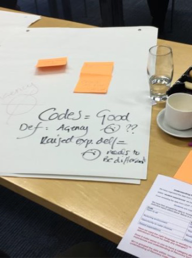
We worked alongside LEAP members to develop a best practice framework for Patient and Public Involvement in analysing qualitative data called collaborative data analysis (related publication can be found here). An important part of the RECOLLECT programme is involving people with lived experience of mental health issues in the research, not just as participants or consultants, but as Patient and Public researchers who conduct interviews, analyse data, and co-author papers.
Over four meetings, LEAP members added to knowledge gained from a systematised literature review to pilot the collaborative data analysis process using the change model development discussed above. One of the LEAP members discusses this experience below, reflecting on both the process involved and the rewards of seeing the final change module come into fruition:
I have experience of mental health difficulties and didn’t attend a Recovery College, so this informed my perspective/experience of all the LEAP meetings I took part in. We were asked what we thought a Recovery College was and how they worked, so as to help the research team shape the Fidelity Measure and discuss the essential items that make RCs work. This was quite tough, but rewarding, as we needed to make sure these items could be robustly measured and would be reliable over time.
The research team asked us to give feedback on a framework they had developed to help understand how RCs work in different ways for different people, considering any language issues, what mattered to us and whether it all made sense. We worked in pairs, after being briefed about qualitative research and how to bring our own perspectives and skills/knowledge to the LEAP.
At the most rewarding of all our meetings, we brought all our conclusions together from the coding and framework developed at previous sessions, related them to each other and created a Change Model. We also gave suggestions for future research on RCs and Recovery in general, and how a LEAP might deliver on that.
RECOLLECT in 2021 and beyond: Understanding why some Recovery Colleges work better
Looking forward, qualitative methods will play an important role in helping to understand how contextual factors influence the way in which Recovery Colleges are delivered and the outcomes that they produce in students and staff. This year, we will interview Recovery College managers about a range of topics, including how the COVID-19 pandemic has affected their work. At present, the team are collaborating with Recovery Colleges across England and the LEAP to find out what issues they think we should explore in the interviews.
In years 3 and 4 of the project, we will conduct a qualitative case analysis at 6 Recovery College sites to delve deeper into how variation in the way Recovery Colleges are organised, influences the work that they do and the impact that Recovery Colleges have on students. We will do this by interviewing Recovery College staff (including managers, commissioners, and peer and non-peer trainers), and running focus groups with students attending the Recovery Colleges. Using a framework coproduced by the research team and the LEAP, we will analyse this to finalise the RECOLLECT programme theory work that began in the first phase.
Over the course of the project, we hope to have a number of PhD and MSc students contributing to areas outside the funding remit of the main RECOLLECT work streams. Bryher Bowness will soon start a PhD to explore how carers use Recovery Colleges. Here qualitative methods will be used to give voice to this previously overlooked group:
As a PhD student working alongside RECOLLECT 2, I am hoping to evaluate the benefits of attending Recovery Colleges for carers. Carers and family members are also involved in the Recovery college, making up roughly around 10% of students. Research so far has mostly looked at students who identify as service-users or staff.
Carers/ family members may have distinctly different motivations and barriers for attending, and qualitative methods will help to better understand their experiences of involvement with Recovery Colleges and uncover the mechanisms and outcomes that are relevant to carers in the Recovery College. Building the project on the insights of initial focus groups with carers involved in the Recovery College will ensure that the study is asking the questions that really matter for family/ carers for family/ carers of people with mental health problems.
We’re excited to build upon the good work from the first phase of RECOLLECT, with the added challenge of adapting our methods to the COVID-19 world. We will be updating QUAHRC with information about how the project is progressing.
For more information, please visit the links below in “RECOLLECT Resources”.