Qualitative Lead(s)
Professor Vanessa Lawrence
Project Lead & Team
Chief Investigator: Matthew Hotopf
Grace Lavelle, Hannah Grace Jones, Elly Alywin-Foster, Ewan Carr, Alan Simpson, Lauren Rayner.
Project Dates
2019–2026
Funding Source(s)
King’s Health Partners / Guy’s and St Thomas’ Charity (Multiple Long-Term Conditions Challenge Fund)
Qualitative Design used
- Qualitative Research in Trials
- Participatory and Creative Research
- Exploring Illness, Wellbeing and Recovery Experiences
- Evaluating Services and Interventions
- Developing and Adapting Interventions
Field of Research
Long-term conditions; digital mental health; peer support interventions; participatory health research, depression.
Geographic/Contextual Setting
UK community and online settings involving adults living with long-term physical health conditions.
Co-produced Online Peer Support and Psychoeducation for People Living with Long-Term Physical Health Conditions
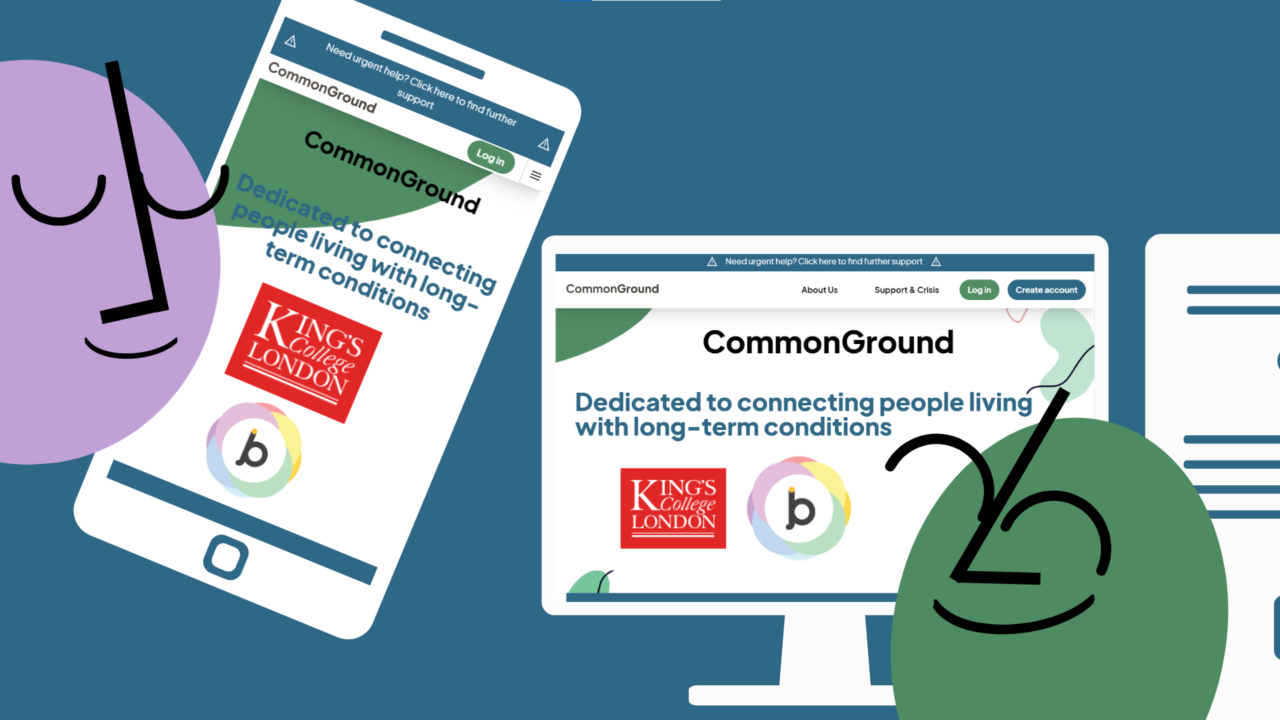
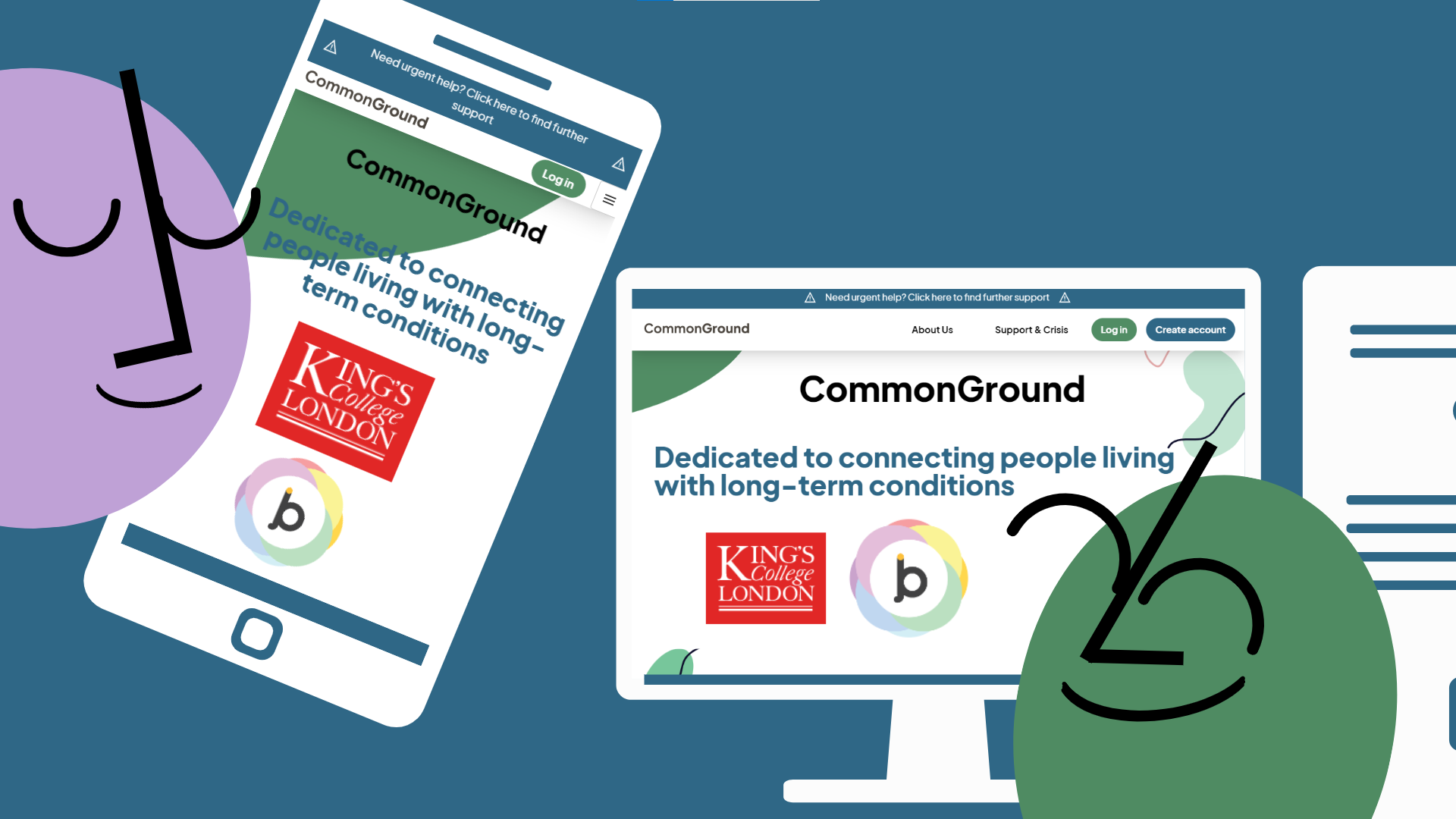
COMMON GROUND is a participatory, multi-phase programme developing and evaluating the acceptability and usability of a co-produced online peer-support and psychoeducation platform designed to support people living with long-term physical health conditions experiencing subthreshold depression. The programme integrates sequential qualitative phases, including needs assessment, co-design, usability testing, moderation research, and theory-of-change development and refinement, alongside a mixed-methods feasibility randomised controlled trial.
Qualitative Approach and Methods
Aim of the qualitative component
To co-produce, optimise, and evaluate the feasibility of an online peer-support intervention grounded in the lived experiences, psychosocial needs, and engagement preferences of people living with long-term physical health conditions, and to understand intervention mechanisms and implementation considerations.
Qualitative methodology
A multi-phase participatory qualitative research programme embedded within the Medical Research Council framework for complex interventions, integrating a four-stage co-production framework and Theory of Change driven feasibility evaluation.
Which qualitative methods were used?
Phase 1 – Needs assessment:
- Focus groups exploring psychosocial needs, stigma, and support preferences among people living with long-term conditions.
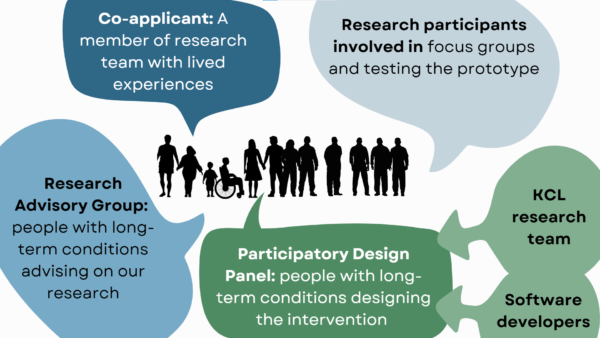
- Lived experience Research Advisory Group to oversee phases 1-5.
Phase 2 – Co-design and intervention development:
- Participatory design workshops involving lived-experience experts, researchers, clinicians, and developers.
- Iterative co-production of platform content, features and intervention mechanisms.
Phase 3 – Usability testing and optimisation:
- Think-aloud usability testing interviews.
- Iterative refinement of intervention content and interface through further co-design workshops.
Phase 4 – Moderation and implementation research:
- Qualitative interviews and focus groups with moderators examining moderation processes, safety procedures, and community governance.
Phase 5 – Theory of Change driven feasibility evaluation
- Individual interviews with a purposive sample of trial participants exploring intervention acceptability, usability, and intervention mechanisms.
- Integration of qualitative findings with engagement metrics and feasibility outcomes to inform the Theory of Change and corresponding intervention design ahead of a definitive evaluation.
Sampling & recruitment
Participants included adults living with long-term physical health conditions experiencing subthreshold depressive symptoms, purposively sampled to ensure diversity in demographic characteristics, long-term conditions, and intervention engagement levels.
Data analysis: how the team made sense of the data
Across phases, reflexive thematic analysis and framework analyses were conducted, with participatory interpretation involving the research advisory group and lived-experience collaborators. Qualitative findings were triangulated with quantitative feasibility metrics, usability measures, and engagement analytics to inform intervention optimisation and future trial design.
Findings, Learning & Impact
Summary of main findings
Qualitative findings across development phases identified substantial unmet psychosocial support needs among people living with long-term conditions and highlighted the importance of inclusive, diagnosis-agnostic peer-support communities, safe moderation practices, and integration of psychoeducational resources. Feasibility-trial qualitative work demonstrated the acceptability of the co-produced platform while identifying priorities for optimisation relating to community engagement, moderation processes, and usability.
Why were qualitative methods used in this project, and what did they enable?
Participatory qualitative methods enabled:
- Co-production of intervention content grounded in lived experience.
- Identification of intervention mechanisms and engagement drivers.
- Iterative refinement of intervention features, moderation policies, and trial procedures.
- Integration of user experience data with feasibility metrics to inform progression to a definitive trial.
Lessons learnt / reflections?
- Participatory governance structures (co-design panel, research advisory group, co-applicant with lived experience) enhance intervention relevance, safety, and implementation readiness.
- Multi-phase qualitative programmes enable continuous optimisation across the intervention lifecycle.
- Moderation, safeguarding, and community governance are central determinants of engagement and sustainability in digital peer-support interventions.
Impact & influence
CommonGround represents a comprehensive participatory qualitative research programme spanning intervention development, optimisation, feasibility testing, and implementation learning. The project demonstrates how co-produced qualitative methodologies can be embedded across the full complex-intervention research cycle to generate scalable, patient-centred digital health interventions.
Links, Outputs & Resources
Links to publications
- Lavelle, G., Jones, H. G., Carr, E., Aylwin-Foster, E., Lawrence, V., Simpson, A., & Hotopf, M. (2025). Online Peer Support for Long-Term Conditions: Protocol for a Feasibility Randomized Controlled Trial. JMIR Research Protocols, 14(1), e71513. Available here.
- Rowlands, H., Aylwin-Foster, E., Hotopf, M., Rayner, L., Simpson, A., Lavelle, G., & Lawrence, V. (2023). A qualitative exploration of the psychosocial needs of people living with long-term conditions and their perspectives on online peer support. Health Expectations, 26(5), 2075–2088. Available here.
- Jones, H. G., Lavelle, G., Aylwin-Foster, E., Regan, C., Simpson, A., Carr, E., Hotopf, M., & Lawrence, V. (2026). Insights and Recommendations From Moderators and Community Members for Keeping Online Peer Support Safe: Thematic Analysis. Journal of Medical Internet Research, 28(1), e81943. Available here.
- Jones, H. G., Lavelle, G., Aylwin-Foster, E., Carr, E., Simpson, A., Hotopf, M., & Lawrence, V. (2026). Coproducing an Online Platform for People With Long-Term Physical Health Conditions: Development and Usability Study. Journal of Medical Internet Research, 28(1), e79666. Available here.
- Jones, H. G., Regan, C., Lavelle, G., Aylwin-Foster, E., Simpson, A., Carr, E., Hotopf, M., & Lawrence, V. (Accepted/In press). Improving CommonGround, an online peer support intervention for people living with long-term physical health conditions and sub-threshold depression: A Theory of Change driven evaluation and thematic analysis (Preprint). Journal of Medical Internet Research. Available here.