
Qualitative Lead(s)
Dr Sharli Paphitis, Dr Sohail Jannesari
Project Lead & Team
Dr Sharli Anne Paphitis, King’s College London – PI
Prof Sian Oram, King’s College London – Co-PI
Dr Sohail Jannesari, King’s College London – Postdoctoral Researcher
Rachel Witkin, Cornelius Katona & Queenie Sit, Helen Bamber Foundation – Practice Partners
Minh Dang, Survivor Alliance – Survivor Leadership & Peer Research
Emma Howarth, University of East London – Collaborator
Nicola Wright, University of Nottingham – Collaborator
Survivor Research Advisory Board and Peer Researchers with lived experience of modern slavery
Project Dates
2021–2023
Funding Source(s)
Modern Slavery and Human Rights Policy and Evidence Centre (Modern Slavery PEC), funded by AHRC / UKRI Strategic Priorities Fund
Qualitative Design used
- Participatory and Creative Research
- Developing and Adapting Interventions
- Systematic Reviews and Evidence Syntheses
- Consensus Building Methods
- Survivor Research
Field of Research
Modern slavery; human trafficking; survivor recovery; wellbeing; reintegration; core outcome sets; participatory research; trauma informed practice; policy and service evaluation
Geographic/Contextual Setting
UK led with international participation; survivor, NGO, policy and research contexts
The Modern Slavery Core Outcome Set (MSCOS) is a survivor‑driven, consensus‑based framework that defines a minimum set of outcomes that should be reported in research, policy, and interventions supporting the recovery, wellbeing, and reintegration of adult survivors of modern slavery and human trafficking. Developed through participatory qualitative research and international consensus methods, MSCOS aims to improve the quality, comparability, and survivor‑relevance of evidence and practice in the field.
Qualitative Approach and Methods
Aim of the qualitative component
To identify, define, and reach consensus on a survivor‑informed set of core outcomes that meaningfully reflect recovery, wellbeing, and reintegration following modern slavery, and that can be embedded across research, policy, and service evaluation.
Qualitative methodology
Participatory qualitative research combined with consensus‑based methods, underpinned by relational ethics and trauma‑informed principles.
Which qualitative methods were used?
- Rapid systematic reviews (qualitative, quantitative, and grey literature)
- Secondary qualitative analysis of survivor interviews
- Primary qualitative interviews with under‑represented survivor groups
- Participatory exploratory workshops
- International E‑Delphi consensus process
- Final consensus workshop
Sampling & recruitment
Survivors of modern slavery and human trafficking were recruited through survivor‑led organisations and established support networks, ensuring diversity in exploitation type, gender, nationality, and pathways through support systems. Survivors formed the majority of participants in workshops and Delphi rounds, with survivor responses weighted more heavily in consensus decisions. Policymakers, service providers, clinicians, and academics were recruited as additional expert stakeholders. Peer researchers with lived experience were embedded throughout the project lifecycle.
Data analysis: how the team made sense of the data
Outcomes were extracted and synthesised across reviews and qualitative datasets using iterative qualitative coding and categorisation. Reflexive thematic analysis informed the qualitative review, while constant comparison supported outcome refinement. Consensus was developed through a structured three‑round E‑Delphi process followed by collective deliberation in a final consensus workshop, ensuring survivor priorities shaped the final outcome set.
Findings, Learning & Impact
Summary of main findings
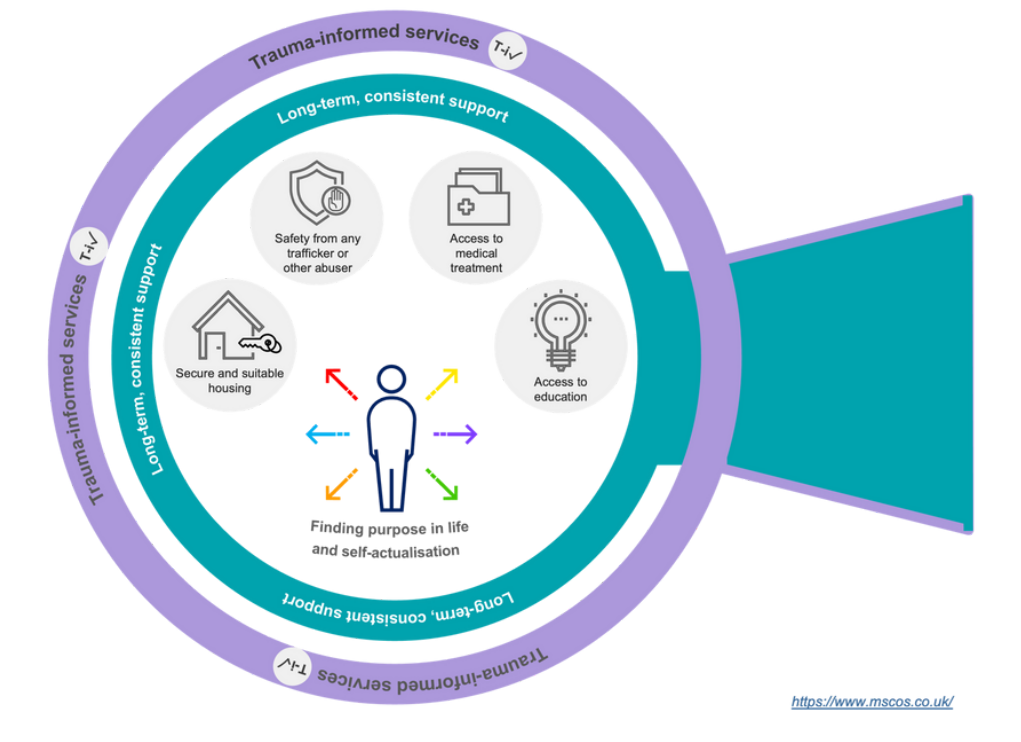
The project identified seven core outcomes that should be reported, as a minimum standard, in interventions supporting adult survivors of modern slavery: secure and suitable housing; safety from traffickers or other abusers; long‑term, consistent support; compassionate, trauma‑informed services; finding purpose in life and self‑actualisation; access to medical treatment; and access to education.
Why were qualitative methods used in this project, and what did they enable?
Qualitative and participatory methods were essential for capturing outcomes that survivors themselves identify as meaningful, many of which are overlooked by narrowly clinical or short‑term evaluation frameworks. Survivor‑led qualitative inquiry enabled a holistic, multi‑level understanding of recovery that spans individual, relational, institutional, and structural domains.
What was innovative, challenging, or particularly successful about the project’s use of qualitative methods?
- Survivor leadership embedded as peer researchers and decision‑makers rather than advisory‑only roles
- Integration of qualitative synthesis with international consensus methodology
- Explicit weighting of survivor voices in consensus decisions
- Development of outcome descriptors with qualitative indicators to support real‑world implementation
Lessons learnt / reflections?
The project highlighted the ethical, emotional, and practical labour involved in survivor‑led research, reinforcing the importance of flexibility, transparency, remuneration, and trauma‑informed supervision. It also demonstrated that recovery outcomes are non‑linear and require long‑term, systems‑level thinking rather than time‑limited intervention models.
Impact & influence
MSCOS provides a shared framework now used to inform research design, service evaluation, policymaking, and funding decisions in the modern slavery field. Impacts include improved comparability of evidence, stronger survivor‑centred service design, establishment of an international Community of Practice, and foundations for future intervention development and outcome measurement.
Links, Outputs & Resources
Links to publications
- Jannesari, S., Damara, B., Witkin, R., Katona, C., Sit, Q., Dang, M., Joseph, J., Howarth, E., Triantafillou, O., Powell, C., Rafique, S., Sritharan, A., Wright, N., Oram, S., & Paphitis, S. A. (2024). The Modern Slavery Core Outcome Set: A Survivor-Driven Consensus on Priority Outcomes for Recovery, Wellbeing, and Reintegration. Trauma, Violence, & Abuse, 25(3), 2377–2389. Available here.
- Damara, B., Jannesari, S., & Paphitis, S. (2025). Trust at Work: Lessons Learned From Co-Researchers Who Have Experienced Human Trafficking. International Journal of Qualitative Methods, 24, 16094069251397350. Available here.
Links to reports or briefs
- Modern Slavery PEC | Modern Slavery Core Outcome Set
- The Modern Slavery Core Outcome Set - Human Trafficking Search