Profile image

Professor Vanessa Lawrence

QUAHRC Head and Professor in Qualitative Health Research

I am an applied qualitative health researcher with a strong commitment to centring lived experience and amplify marginalised perspectives.  My work focuses on mental health and long-term conditions, with an emphasis on developing, refining and evaluating interventions that reflect the priorities and everyday realities of the people they are designed to support.

I work collaboratively with clinicians, service providers, policy partners, industry and the voluntary sector to embed high-quality qualitative research across all stages of research studies. I have led qualitative components within large, multidisciplinary programmes that have generated novel and impactful interventions.  These include the co-production of an online peer support platform for people with chronic health conditions at risk of depression (CommonGround) and psychological therapies for people living with dementia (PATHFINDER), Motor Neuron Disease (COMMEND) and anxiety in later  life (FACTOID).  I also undertake theory informed qualitative work that provides real time insights to inform study design, for example by enhancing clinical trial recruitment (BOPP) and examining barriers to trial delivery in eating disorder services (DAISIES).

Partnership with experts by experience is central to my approach. I train, support and work alongside lived experience co-researchers.  For example, within the national evaluation of Recovery Colleges (RECOLLECT), we developed a collaborative data analysis approach to meaningfully involve lived experience co-researchers in a mental health context. I also have a strong interest in innovative and inclusive qualitative methods, including digital qualitative diaries, which we are currently using to explore treatment experiences among people with eating disorders (EDEN).

As Head of QUAHRC at King’s College London, I am committed to building a collaborative and supportive community of qualitative researchers.   As Qualitative Lead for the NIHR King’s College London Mental Health & Neuroscience Research Support Service, I support national research capacity and promote high-quality qualitative methods across research designs. I also co-lead the Qualitative Research MSc module at King’s College London and the QUAHRC Summer School. I am keen to develop new partnerships that use qualitative research to inform practice, policy and innovation, and to deliver real-world benefit for people and services.
Key Research Projects

Picture of the adept logo - a stylised drawing of a woman with long hair cradling a baby

ADEPT

Optimising Psychological Treatment for Anxiety Disorders in Pregnancy — A Feasibility Study of Time-Intensive Versus Weekly Cognitive Behavioural Therapy

A woman on the sofa looking at her phone with a TCDS device on her head

BDEP

Home-based Transcranial Direct Current Stimulation in Bipolar Depression

The BOPPP logo - there is a liver above the B in boppp and the O is made of an intestine or something similar

BOPPP

Beta-blockers or Placebo for Primary Prophylaxis of Oesophageal Varices

COMMEND

Acceptance and Commitment Therapy for Improving Psychological Health in People with Motor Neurone Disease

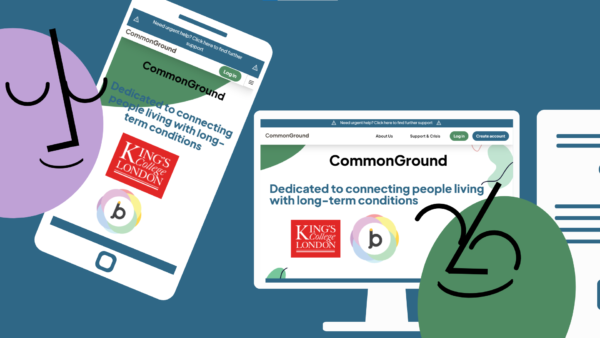
abstract faces reading the commonground website on a phone and desktop computer

CommonGround

Co-produced Online Peer Support and Psychoeducation for People Living with Long-Term Physical Health Conditions

Daisies logo - the letters spelling daisies, with a daisy as the "I".

DAISIES

Stepping into Day Treatment versus Inpatient Treatment for Adults with Severe Anorexia Nervosa

EDEN project logo

EDEN

Ketamine for the Treatment of Depression in Severe and Enduring Anorexia Nervosa

FACTOID

Development and Feasibility of Acceptance and Commitment Therapy (ACT) for Older People with Treatment-Resistant Generalised Anxiety Disorder

A woman on the sofa looking at her phone with a TCDS device on her head

HOME

Home-based Transcranial Direct Current Stimulation in Major Depressive Disorder

An abstract closeup of a pattern of hexagons

OPEN

Olanzapine for young PEople with aNorexia nervosa: An open-label feasibility study to test recruitment, treatment acceptance, adherence, safety, outcome measures and patients’ experience to prepare for a randomised placebo-controlled trial

PATHFINDER

Problem Adaptation Therapy for Individuals with Mild to Moderate Dementia and Depression

PETALS

An exploration of treatment and recovery experiences in eating disorders and evaluation of the utility of qualitative diary methods in eating disorders research

Reach logo

REACH

Young People’s Experiences of Education, Inequality and Mental Health During COVID-19 Lockdowns

An abstract image of circles, half circles and squares

RECOLLECT

Recovery Colleges Characterisation and Testing

Picture of a silhouette of a head with a colourful atoms design inside

SHAPED

Study of Visual Hallucinations in Parkinson’s Disease, Eye Disease and Dementia

WHELD logo - the word wheld with "improving wellbeing and health for people with dementia" written around it.

WHELD

Well-being and Health for People with Dementia in Care Homes

Related resources and content

abstract faces reading the commonground website on a phone and desktop computer
Research projects & expertise

CommonGround

Co-produced Online Peer Support and Psychoeducation for People Living with Long-Term Physical Health Conditions

Image with cartoon figures, a photo of a phone and a tablet, and the text Commonground: engagement, feedback, and the future
News

Insights from our first CommonGround trial: engagement, feedback, and the future

The CommonGround team shares findings and insights from their trial of an online peer support platform for those living with long term health conditions.

A colourful cartoon of figures engaging with different parts of the CommonGround resources
News

Peer Support in Action: Observations from the CommonGround community

The CommonGround research team share reflections on watching the birth and growth of a peer support online community for people with long-term conditions.

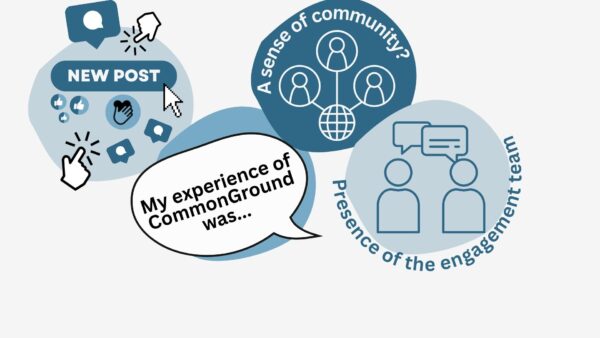
alt="four circles with icons and text: new post; a speech bubble wth "my experience of commonground was.."; a sense of community?; presence of the engagement team"
News

“Are you engaged?” How do we measure user engagement on CommonGround?

In the second of their blogs on engagement, Hannah Jones and Grace Lavelle explore further the idea of engagement in online communities in relation to CommonGround, a peer support community for people living with long-term conditions. What is the best way to measure engagement appropriately for this unique project?
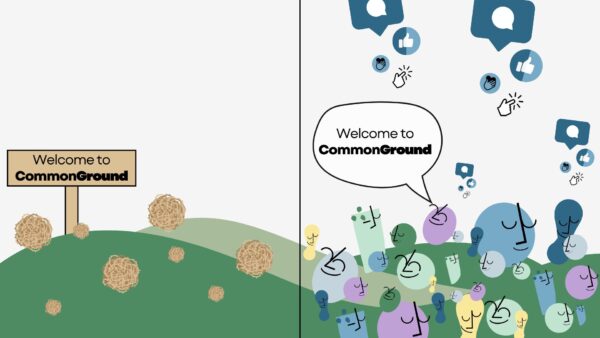
Graphic of abstract people on a green hill, with the speech bubble "Welcome to CommonGround"
News

CommonGround: avoiding tumbleweeds in the community

Hannah Jones and Grace Lavelle from the CommonGround project reflect on the idea of engagement in online spaces and how it applies to CommonGround’s online peer support community for people with long term conditions. They discuss the questions: what is ‘engagement’ in online communities and what kind of engagement do we hope to observe on CommonGround?


Abstract cartoon characters with different physical body parts highlighted, all sharing a speech bubble
News

For you, by you: Developing online peer support for people with long-term conditions

How the CommonGround team co-developed a peer support platform for people with long-term health conditions.