
Impact in Qualitative Research: Rosie Cammack on taking a queer qualitative approach to collecting demographic information
Rosie is a Research Assistant in the Global Health and Social Medicine Department at King’s College London, working on the Environmentally Sustainable HeAlth REsearch (SHARE) project. Alongside her role at King’s, Rosie also works as an Expert by Experience Involvement Worker at South London and Maudsley NHS Foundation Trust, supporting people with a learning disability to work for the NHS. Rosie completed the Global Health, Social Justice and Public Policy MSc at King’s College London in 2023. In this blog Rosie reflects on the qualitative methods she utilised in her Master’s dissertation project.
Whilst undertaking the Global Health, Social Justice and Public Policy MSc at King’s, I developed a passion for qualitative research. The Master’s programme culminates in a dissertation, an in-depth research project that allows students to specialise in an area of interest. I chose to explore queer people’s perspectives on normalising testing for Sexually Transmitted Infections (STIs), using qualitative research methods. A substantial body of research about sexual health has been conducted within the queer community, but this has almost exclusively focused on cisgender “men who have sex with men”. I wanted to engage with people that are underrepresented in sexual health research (namely people that identify as lesbian, bisexual or queer women, non-binary, transgender and/or intersex). This was a difficult decision for me, as I fundamentally believe that sex/gender and sexual orientation are fluid and unstable identities, but centring a neglected perspective took precedence for me. I sat with the discomfort of this throughout the research.
If participants felt it was not possible to describe in words how they identify their sex/gender or sexual orientation, that is in fact data within itself.
I decided to utilise a qualitative questionnaire. I constructed 10 open ended questions, to explore people’s perceptions and experiences of sexual health care services, with free text boxes for participants to respond in their own words. I was still grappling with my decision to name specific queer identities in the inclusion criteria. I recognised that queer realities are more nuanced and diverse than the identities I named in the invitation to participate. Therefore, in consultation with my fantastic supervisor Dr Shagufta Bhangu, I decided to take a qualitative approach to asking people’s sex/gender and sexual orientation, providing them with an open text box to describe their identity in their own words. Every question in the questionnaire, including the demographic section, was optional, so people could skip a question if they did not feel comfortable answering it. I resisted the notion that this could create a ‘gap’ in the data. As, for example, if participants felt it was not possible to describe in words how they identify their sex/gender or sexual orientation, that is in fact data within itself, and a refusal to answer would be the most honest representation of that individual, as opposed to them being artificially placed within a category they do not identify with or literally othering them through an ‘other’ option.
Once I finalised the questions, I shared the questionnaire through queer support and social groups across the UK. I was blown away by the response! I was very conscious of the sensitive nature of the research topic, so I shared the project gently using a flyer, never directly asking any individuals to participate. 52 people completed the questionnaire, and all participants answered every question, apart from one participant who left one question blank. Every participant chose to answer the optional demographic questions. The terms participants used to describe their sex/gender and sexual orientation are visually represented in the word clouds below (Figures 1 and 2 respectively). The size of the term reflects the frequency with which it was used.
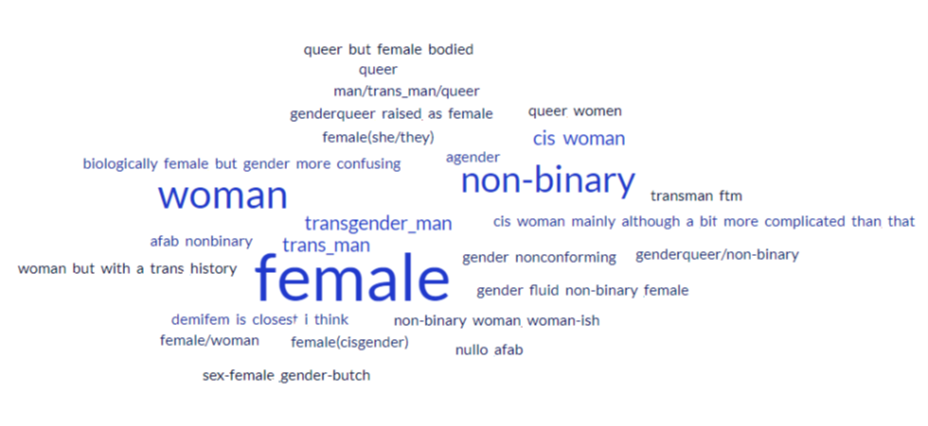
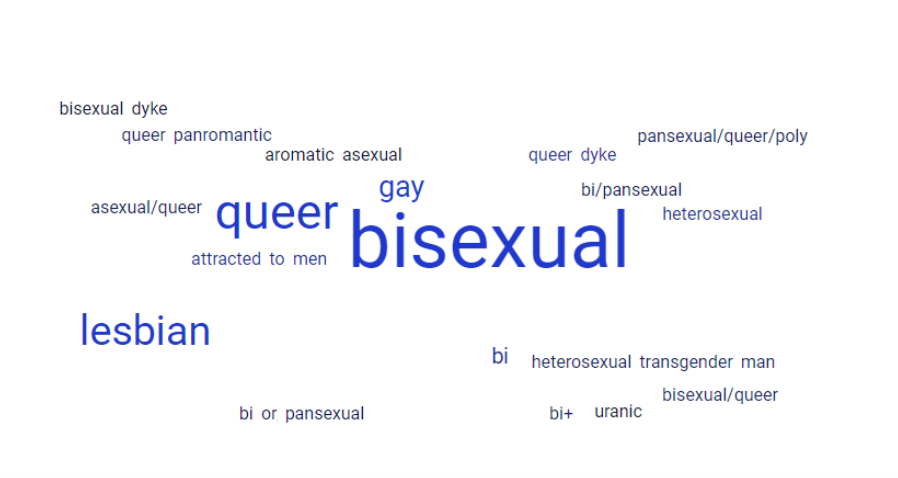
I was delighted to see the range of terms participants used to describe their sex/gender and sexual orientation. To me, it underlines the importance of allowing people to self-describe these identities, as they engage with a variety of terms, including some I was unfamiliar with. Creating new language and reclaiming pejorative terms is common in the queer community, for example several participants used ‘dyke’ to describe their sexual orientation. Many of these new or reclaimed terms are not institutionalised within medicine or law but are terms that queer people genuinely use in their day to day lives. Here a quantitative approach, with a limited number of pre-determined categories, would not have provided space for all participants to authentically express their sex/gender and sexual orientation.
At the end of the questionnaire, I included a free text box for participants to provide any final thoughts or feedback. One participant noted ‘it was good to be able to write my opinion, but it was also very time taking’, highlighting the extra effort required from participants to answer qualitative questions. This would encourage me in the future to limit the number of qualitative questions. Another participant used the text box as a space to say, ‘Thanks for researching this topic’.
When I look back on my dissertation, I feel proud of my decision to make the demographic questions qualitative. How people are represented in data matters. Who is or is not ‘counted’ has real life implications, particularly for people from marginalised communities. We can (hopefully) all agree that health research should strive to improve health outcomes and reduce inequalities. But histories of power have informed how identities are constructed and valued, and resultantly, how people are categorised through research. Demographic questions have the power to visualise or erase people’s experiences and needs. I believe data about people’s identities plays an essential role in justice and equality[1]. Therefore, I think it is crucial that researchers critically engage with the design of demographic questions. This will undoubtably present practical difficulties to researchers. Historically, demographic questions have been shaped by heterosexual and cisgender norms, so reimagining them will require work. I recognise that the scale of this project facilitated a qualitative approach. A larger scale study would require significant investment to analyse a completely qualitative dataset. However, I would argue that this investment is justified, in order to more meaningfully represent the complex and nuanced reality of queer experiences, particularly with respect to sex/gender and sexual orientation. Alternatively, researchers may create other approaches that aim to engage more meaningfully with queer lives. My greatest learning from the dissertation was that justice is more important than ideas about what ‘good research’ traditionally looks like!
[1] For a more thorough and insightful discussion on this please see Ruberg, B., & Ruelos, S. (2020). Data for queer lives: How LGBTQ gender and sexuality identities challenge norms of demographics. Big Data & Society, 7(1), 2053951720933286.